Prevent Further Property Damage
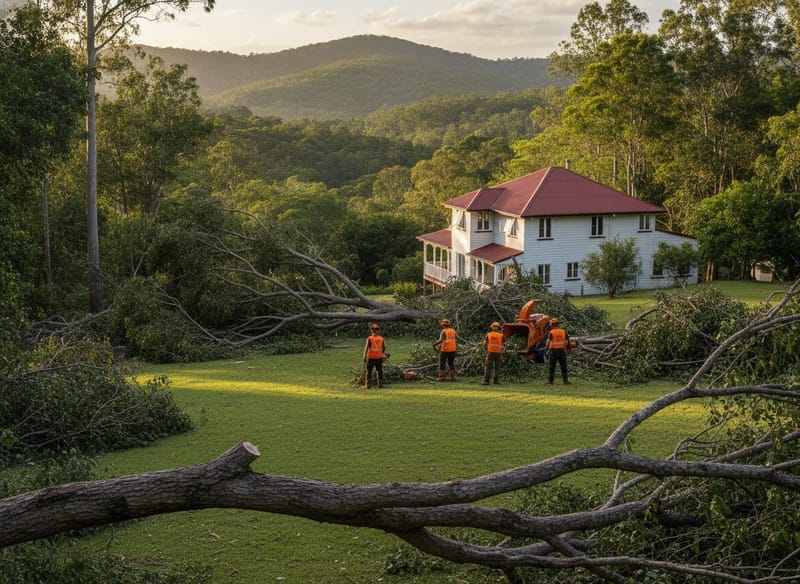
Carefully dismantling fallen timber prevents secondary structural damage to your roofline and walls.
We make safe and remove fallen and dangerous trees threatening homes, driveways, and fences in Innes Park
Covering tree hazards across Innes Park, Coral Cove, Bargara, and Elliott Heads.
When severe weather strikes the coast, emergency tree removal Innes Park homeowners rely on is critical to securing property. We make safe and remove fallen and dangerous trees, eliminating immediate structural threats and restoring safe access.
During severe east coast lows and monsoon troughs, Innes Park's sandy coastal soils become waterlogged. High winds cause whole-tree root plate failures in shallow-rooted species. Our team uses specialised winching and crane-assisted rigging to secure root plates before cutting.
Carefully dismantling fallen timber prevents secondary structural damage to your roofline and walls.
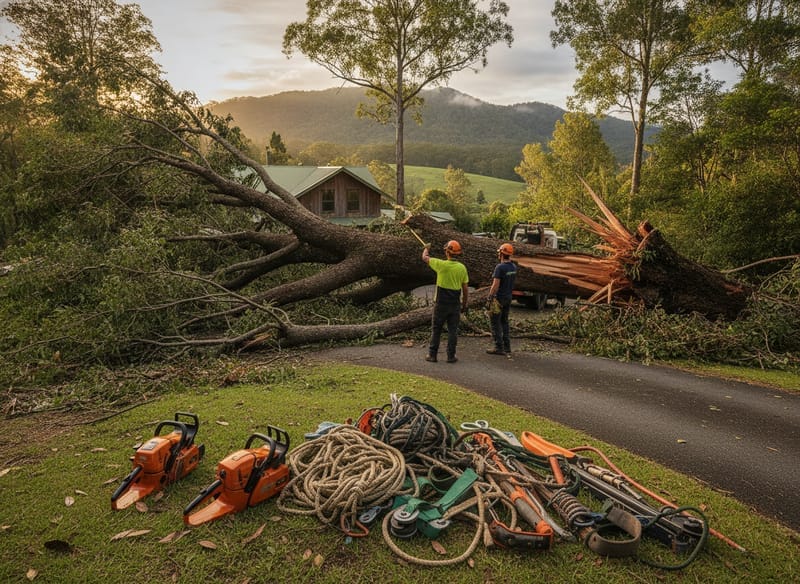
We quickly cut through heavy trunks and clear blocked driveways and pedestrian access points.
We provide detailed itemised invoicing and photographic records of the hazard for your insurer.
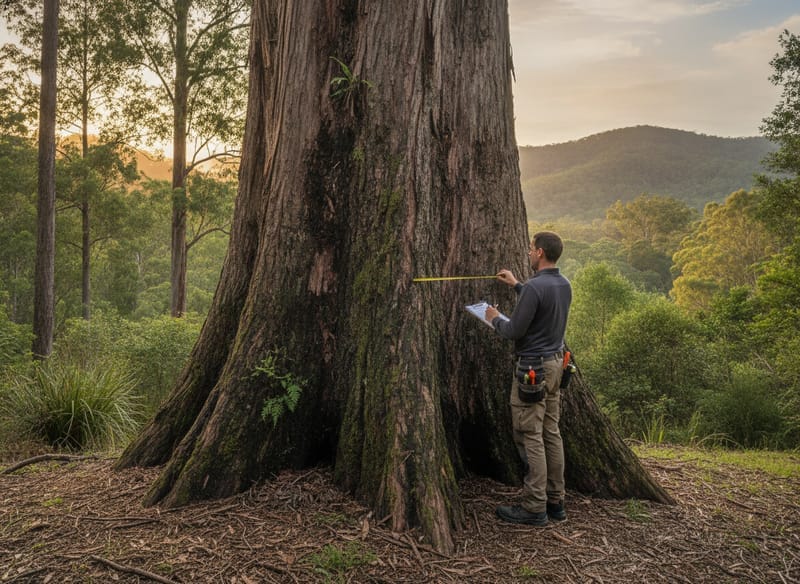
We inspect the fallen or leaning tree on your Innes Park property, identifying electrical risks and tension points.
Our crew secures the tree with heavy-duty ropes and winches to prevent shifting while work begins.
We cut and relieve branch tension systematically, lowering timber away from the damaged structure.
Brush is chipped and heavy logs are removed or placed safely away from buildings.
When severe summer storms hit the Bundaberg coast or heavy easterly winds shear through established canopies, properties in Innes Park often face unexpected and catastrophic tree failures. Whether a mature Hoop Pine has dropped a massive limb on your roofline, or a salt-battered Cotton Tree is leaning dangerously toward your boundary fence, you need urgent, professional help. Our team provides dedicated Emergency Tree Removal Innes Park to keep your home, family, and property safe when disaster strikes. We understand that coastal blocks carry unique risks. The sandy, salt-exposed soils along the coastal strip can become heavily saturated during east coast lows, severely weakening root structures and causing whole-tree uprooting. If a tree has failed, is partially uprooted, or is hung up in the canopy, our climbers and ground crews are ready to respond. We focus on securing the site rapidly and cleanly, preventing further structural damage to your property while managing all the hazards of a storm-damaged landscape. When emergencies happen, we are the local arborists you can rely on to bring heavy equipment and expertise straight to your door.
Tackling a fallen or fractured tree without professional training is incredibly dangerous, especially in the chaotic aftermath of a severe coastal storm. Hung-up branches, tensioned timber, and structurally compromised trunks behave unpredictably when cut. Homeowners or unqualified operators who attempt their own clearing often risk severe injury. They also frequently cause secondary damage to roofs, powerlines, and fences when the immense weight of the tree unexpectedly shifts or rolls during a cut.
Furthermore, unqualified operators lacking proper public liability insurance or AQF Level 3 certifications can leave you financially exposed if something goes wrong during a high-stakes removal. We approach every Emergency Tree Removal Innes Park with strict safety protocols and industry best practices. We never take shortcuts when your property is on the line.
Our qualified arborists understand the extreme forces trapped in wind-thrown timber. If a storm-damaged tree can be safely salvaged through restorative pruning, we follow AS4373 Pruning of Amenity Trees standards to carefully remove the hazard without destroying the tree's future viability and structure. However, if the tree is entirely failed or imminently dangerous, we use precise dismantling techniques to get the whole tree gone safely. We handle the intense, high-risk work so you do not have to, protecting both your property and your peace of mind.
Responding to an emergency requires specialized gear and specialized knowledge. Our local crew deploys targeted methods to stabilize and remove hazardous timber from your property safely, utilizing techniques tailored specifically for tight coastal blocks and extreme storm damage.
When a tree has impacted a structure or powerline, our first priority is stabilization. We use heavy rigging, winches, and load-rated ropes to secure leaning trunks and suspended limbs. This help prevents further collapse and secures the hazard before the full dismantling process begins.
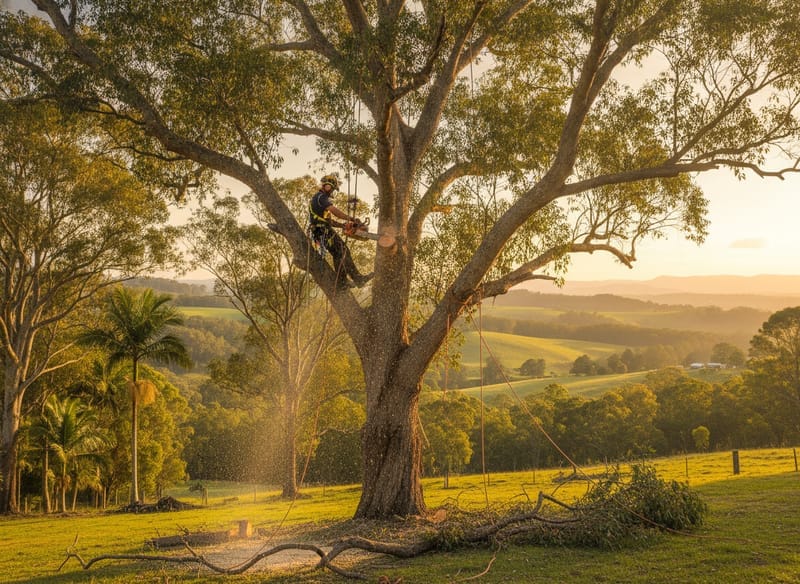
For residential blocks with tight side access or coastal gully drops where elevated work platforms (EWPs) cannot reach, our AQF Level 3 climbers utilize advanced double-rope techniques. We carefully rig and lower heavy sections of storm-damaged timber to the ground in controlled stages, protecting the structures below.
When a massive Hoop Pine or Norfolk Island Pine has catastrophically failed over a house, we coordinate crane-assisted removals. This specialized operation allows us to lift multi-ton sections of timber straight up and away from the roofline without putting any additional stress or weight on your compromised home.
Once the hazard is safely on the ground, our ground crews use commercial top-handle chainsaws and high-capacity ground saws (such as the MS500i) alongside 12-inch wood chippers to rapidly process the debris. We clear the vegetative waste from your yard completely, so rebuilding and site repairs can commence without delay.
When a massive tree comes crashing down, you need a rapid, organized response to secure your property. Here is exactly how we handle your Emergency Tree Removal Innes Park from the moment you call our team. Step 1: Assessment and Dispatch When you contact us with an emergency, we ask for critical details—is the tree resting on a house, blocking an access road, or tangled near powerlines? We dispatch our crew to your Innes Park address as a priority, arriving fully equipped with heavy machinery, rigging gear, and commercial chainsaws. Step 2: Hazard Evaluation and Make-Safe Upon arrival, our lead arborist assesses the structural integrity of the tree and the immediate environment. We document the damage with photographs for your insurance records. We then establish an exclusion zone and perform an immediate "make-safe" to stabilize leaning trunks or hanging limbs. Step 3: Controlled Dismantling Using elevated work platforms, spider lifts, or rope-access climbing, we carefully dismantle the hazard. We rig and lower heavy timber piece by piece to avoid secondary damage to your home, fencing, or underlying landscaping. Step 4: Complete Site Cleanup We chip the canopy, cut the larger logs into manageable lengths, and remove all storm debris from your property. Our tipper trucks haul the waste away, leaving your site safe, clean, and ready for your insurance assessor or local builder to begin their work.
Emergency tree work carries immense risk, which is why absolute compliance and safety are non-negotiable for our team. We are fully public liability insured and carry comprehensive WorkCover for all our staff, protecting you completely while we operate on your block. Our crew members hold all essential high-risk tickets, including elevated work platform (EWP) operation, working at heights, traffic management, and advanced tree felling units. All our on-site leaders are minimum AQF Level 3 qualified arborists, while complex risk assessments and structural root zone evaluations under AS4970 are guided by our AQF Level 5 consulting arborist. Whether it is a removal or hazard mitigation, every job aligns strictly with safe work protocols and Australian industry standards.
Innes Park presents unique challenges for tree stability. The coastal strip is heavily exposed to fierce easterly winds and salt shear, which regularly batter mature Pandanus, She oaks, and towering Hoop Pines. When heavy summer rain drenches the sandy soils along the coastline, root plates can rapidly fail, leading to whole-tree uprooting across established retiree blocks.
Navigating the Bundaberg Regional Council Planning Scheme 2015 during an emergency is critical. Properties near the beach may fall under the Coastal protection overlay or the Sea turtle sensitive area overlay. However, if a tree is dead, dying, or imminently dangerous, it can typically be removed under emergency provisions.
Importantly, following the devastating Burnett River floods, a state disaster clearing exemption remains live until 9 March 2027. This exemption allows landholders to clear woody debris and fallen trees to prevent property loss or environmental damage without a formal council pathway. Our team ensures all emergency removals are properly photographed and documented to keep you fully compliant.
Once the emergency tree removal is complete and the immediate hazard is cleared, the recovery of your landscape begins. We highly recommend monitoring the remaining trees on your property, especially if the storm altered local windbreak dynamics. Trees that were previously sheltered may now be exposed to high coastal wind loads and could require preventative canopy thinning. If we had to leave a stump in place due to structural debris or highly saturated ground, contact us to schedule professional stump grinding once the soil dries out. Finally, be sure to retain the photographic evidence and the itemized arborist tax invoice we provide—these are essential documents for finalizing your home insurance claims swiftly.
Emergency tree work is priced according to the complexity, safety risks, and equipment required to make the site safe.
We provide transparent, itemised pricing for make-safe and removal work suitable for insurance submission.
We attend to tree hazards throughout Innes Park and neighbouring districts.
Our experienced arborists make safe and remove fallen and dangerous trees across Innes Park.
Call for Assistance