Council Application Approval
Avoid development delays with thorough, professionally formatted reports that address all planning scheme requirements.
Independent AQF Level 5 consulting arborist reports for council approvals, development applications and tree risk assessments.
Providing consulting reports across Burnett Heads, Bargara and Bundaberg.
An Arborist Report Burnett Heads is required when undertaking property development, resolving boundary disputes, proving tree hazardousness, or applying to clear vegetation inside mapped council overlays. Our AQF Level 5 consulting arborists provide comprehensive written evaluations that satisfy statutory bodies and planning certifiers.
Properties in Burnett Heads often intersect sensitive coastal environments, including turtle rookery buffers and marine park margins under the Bundaberg Regional Council Planning Scheme 2015. Our reports provide the environmental justification required by council planning officers.
Avoid development delays with thorough, professionally formatted reports that address all planning scheme requirements.
Establish clear, objective facts regarding tree health, structural risk, and boundary encroachment.
Incorporate healthy, high-value coastal trees into your architectural designs safely using AS4970 protection guidelines.
We review your site plans, development objectives, or council information requests.
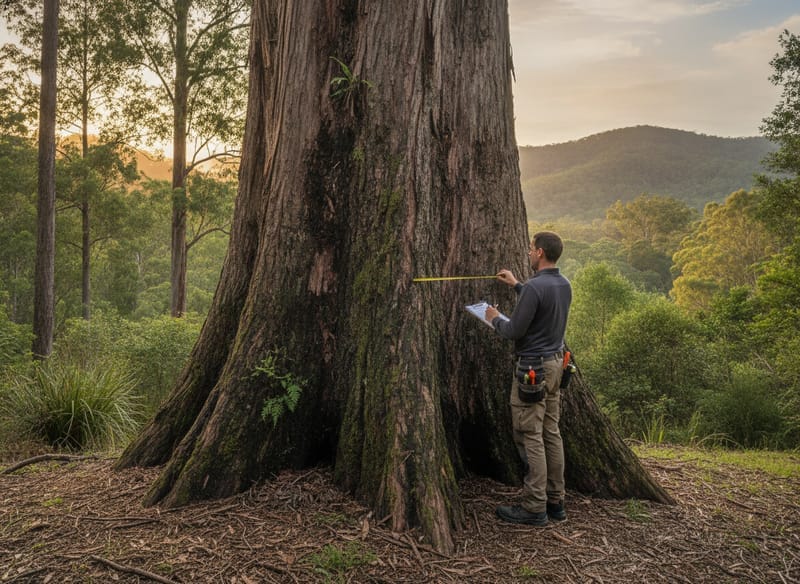
Our AQF Level 5 arborist conducts a comprehensive Visual Tree Assessment (VTA) on site in Burnett Heads.
We calculate TPZ, SRZ, retention values, defect ratings, and overlay mapping compliance.
We provide a fully compliant written report complete with high-resolution photos, site plans, and recommendations.
If you are planning a new build, extending your coastal property, or dealing with a hazardous mature tree, securing an Arborist Report Burnett Heads is often the mandatory first step. As Burnett Heads continues to grow and develop along the coast, the Bundaberg Regional Council strictly enforces tree protection and vegetation management. Whether you are dealing with salt-exposed Casuarinas, remnant Pandanus, or towering Norfolk Island Pines on your block, council requires formal documentation before major site works or regulated clearing can begin.
Our team provides comprehensive, AQF Level 5 consulting arborist reports tailored specifically to the Burnett Heads environment and local planning schemes. We understand the unique subtropical coastal conditions here, from the sandy soils and severe summer storm risks to the specific council overlays that dictate what you can and cannot clear.
Getting the right advice upfront saves you time, money, and stressful development delays. Whether you need a tree protection plan for a builder or a risk assessment for a failing canopy, we deliver detailed, compliant, and actionable reports to keep your project moving forward.
A common and costly mistake we see property owners make is submitting a development application (DA) or a tree removal request backed by an unqualified opinion. Bundaberg Regional Council will not accept a brief letter or a simple quote from a standard tree lopper or an AQF Level 3 climber as justification for removing protected vegetation.
When you submit an invalid or poorly detailed tree assessment, council will bounce the application back. This results in Requests for Further Information (RFIs), causing weeks or even months of delays to your building schedule, racking up holding costs, and frustrating your contractors. Furthermore, if a builder damages a retained tree's root system because a proper protection plan wasn't established, the fines and remediation costs can be substantial.
We solve this by supplying AQF Level 5 consulting arborist reports. Our reports provide the exact data council planners demand—including DBH (Diameter at Breast Height) measurements, SULE (Safe Useful Life Expectancy) ratings, and structural root mapping. By engaging our fully qualified consulting team from day one, you ensure your DA moves smoothly through the council pipeline, and your builders have clear, actionable guidelines to work around retained trees safely.
Our consulting arborists deliver detailed, standard-compliant reports designed to satisfy local authorities and protect your assets. We employ industry-recognised methodologies to assess every tree objectively.
Required by council when construction occurs near existing vegetation. We catalogue all trees on site, identifying species, measuring trunk diameter (DBH) and canopy spread, and assigning a Safe Useful Life Expectancy (SULE) rating to determine which trees should be retained or removed.
When trees are retained on a building site, we calculate and map the Tree Protection Zone (TPZ) and Structural Root Zone (SRZ). The report dictates the exact placement of protective fencing, mulch requirements, and designated work-free zones to prevent soil compaction and root damage during construction.
Utilising Visual Tree Assessment (VTA) principles, we evaluate hazardous trees for structural defects, disease, and decay. We document target zones (houses, footpaths) and assess the likelihood of failure, providing a formal risk rating and actionable mitigation advice.
Where council approval is required to remove a tree under local overlays, we document the tree's poor health, structural instability, or unmanageable risk. This formal justification is necessary to prove why pruning or retention is no longer a viable option.
The process of generating an arborist report requires meticulous on-site data collection and a thorough understanding of local legislation. We manage the entire process from the first site visit to the final PDF delivery.
First, we conduct an initial consultation to understand the scope of your project. Whether you are dealing with a neighbour dispute, a DA submission, or a hazardous tree concern, we clarify exactly what the council or certifier is asking for.
Next, our AQF Level 5 consulting arborist conducts a comprehensive site inspection in Burnett Heads. We measure trunk diameters, map the canopy spreads, assess root structures, and document any structural defects, fungal infections, or storm damage using high-resolution photography.
We then review the data against the Bundaberg Regional Council Planning Scheme 2015. We check for relevant environmental mapping, ensuring our recommendations align with local regulations.
Finally, we draft and deliver a formal, signed PDF report. This document includes all required mapping, methodology, AS4970 or AS4373 references, and clear recommendations. Once approved, our in-house climbing team and machinery operators are fully equipped to carry out the physical tree removal or pruning works exactly as specified.
Every report we produce is written by an AQF Level 5 Diploma-qualified consulting arborist, which is the mandatory credential for development and legal tree reporting in Queensland. Our assessments strictly adhere to AS4970 - Protection of Trees on Development Sites for all construction-related reports, and AS4373 - Pruning of Amenity Trees when prescribing canopy reductions or remedial pruning.
We carry comprehensive Professional Indemnity insurance specifically for our consulting and reporting services, alongside our Public Liability and WorkCover policies for all physical tree work. This gives you complete peace of mind that our advice is fully backed, legally sound, and recognised by local and state planning authorities.
Burnett Heads has a distinct environmental and regulatory landscape. Sitting right on the coast, properties here are subjected to heavy salt burn, severe subtropical storm winds, and sandy, free-draining soils. When producing an Arborist Report Burnett Heads, our team evaluates how these specific coastal stressors impact the structural integrity of mature species like Cotton Tree, Pandanus, and large Norfolk Island Pines.
We also navigate the specific overlays of the Bundaberg Regional Council Planning Scheme. Many blocks in Burnett Heads and neighbouring Bargara trigger the Coastal protection overlay or the Sea turtle sensitive area overlay (due to the proximity of the Mon Repos rookery). Removing vegetation in these zones often requires detailed ecological justification.
Furthermore, the region is still managing the aftermath of the March 2026 Burnett River floods. If you are clearing hazardous storm-damaged timber under the state disaster clearing exemption (active until March 2027), an arborist report provides the vital written and photographic justification required to prove the work was necessary to protect property and life.
Once we hand over your completed arborist report, the next step is usually submitting it to Bundaberg Regional Council alongside your development application or tree clearing permit. Keep a digital copy on file for your certifier and builder.
If the report specifies a Tree Protection Plan, you must install the mandated TPZ fencing and signage before any earthworks or machinery enter the site. The fencing must remain intact for the duration of the build. If the report authorises tree removal or remedial pruning, contact us to schedule our climbing team. We will ensure the physical tree work is executed safely and strictly in accordance with the report's AS4373 specifications.
Consulting arborist reports are priced based on the number of trees assessed, the complexity of the site, and the specific report type.
We supply fixed, upfront quotes for all AQF Level 5 consulting and reporting services.
We provide AQF Level 5 consulting arborist reports across Burnett Heads and all Bundaberg Regional Council suburbs.
Contact our consulting team today for expert tree assessments, DA reports and council guidance.
Request a Report Quote