Safe Outdoor Living
Eliminate hidden dangers like loose hanging limbs and cracked branches lingering in your upper canopy.
Thorough post-storm cleanup, hanging branch removal, and multi-tree hazard clearance
Covering Bundaberg South, Walkervale, Svensson Heights, and East Bundaberg
Summer storms and monsoon lows frequently cause widespread canopy tearing and tree failures across Bundaberg South. We provide full-service storm damage cleanup to restore property safety.
Severe weather systems moving over the Burnett River bring intense wind gusts that tear heavy branches from old Mangos, Jacarandas, and Poincianas in Bundaberg South. Saturated soils often cause whole-tree destabilisation on older urban blocks.
Eliminate hidden dangers like loose hanging limbs and cracked branches lingering in your upper canopy.
Get professional arborist invoices and photographic records for quick insurer assessment and payout.
Transform a storm-ravaged property covered in debris back into a neat, usable yard in a single visit.
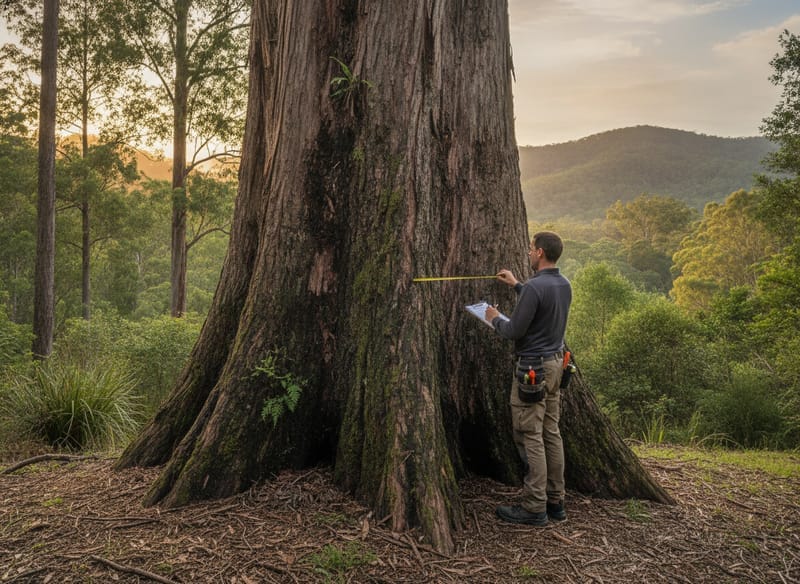
We inspect all trees on site, identifying structural failures, cracked trunks, and hanging canopy debris.
We provide a clear quote and photograph all damage for your records or insurance submissions.
Our arborists cut up fallen trunks, release stored tension safely, and lower damaged upper limbs.
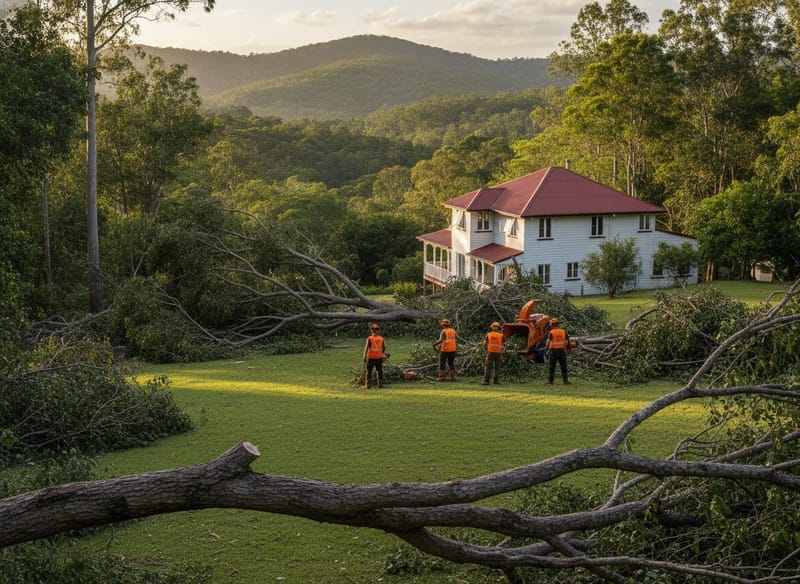
We process all storm debris through our chipper and rake your property clean.
When severe weather strikes, our team is ready to provide safe and efficient Storm Damage Tree Removal Bundaberg South locals can rely on. Bundaberg's subtropical climate brings intense east coast lows, summer thunderstorms, and cyclone remnants that frequently push our urban canopy to its absolute limits. In older, established suburbs like Bundaberg South, Bundaberg Central, and Avenell Heights, large mature trees are particularly vulnerable to sudden structural failure during high winds and heavy rainfall. Saturated soils on the Burnett River flood plain mean that even healthy, deep-rooted trees can suffer sudden root-plate failure, uprooting entirely and threatening property, powerlines, and access routes. Big backyard Mangos, towering Hoop Pines, and historic Jacarandas are staples of our local landscape, but they require expert handling when damaged. Whether you are dealing with a massive snapped limb resting on your roof, a split trunk threatening your driveway, or a completely fallen tree blocking your acreage, our local crew has the heavy equipment and AQF Level 3 climbing arborists to safely dismantle and remove the hazard. It goes to the top of the list to secure your property, protect your family, and prevent further damage to your home.
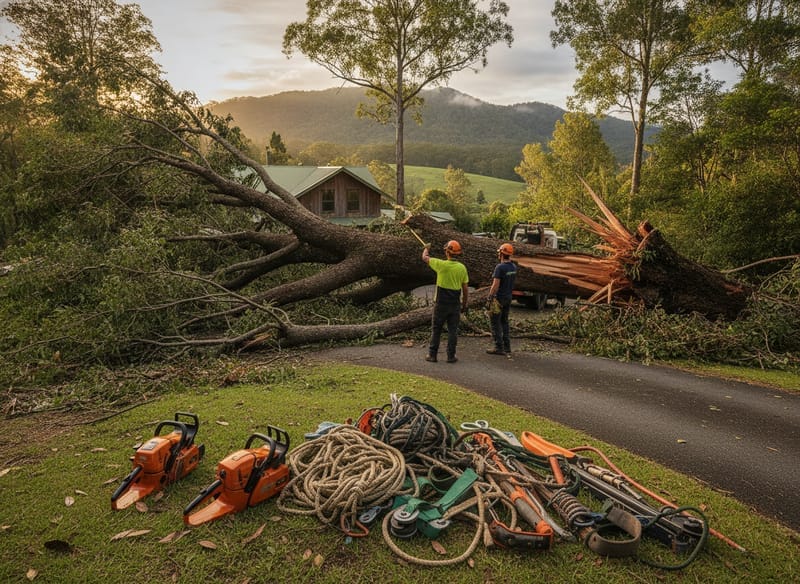
After a major storm or flood event, the temptation to clean up your own property is high. However, tackling storm-damaged timber is arguably the most dangerous task in arboriculture. When large trees like Moreton Bay Figs, flooded gums, or massive backyard Mangos fail, the timber is placed under immense, unpredictable pressure. Snapped limbs become hung-up in the canopy, creating widow-makers that can fall without warning.
Under-qualified operators or homeowners with a hired chainsaw frequently misjudge 'tension wood'—branches bent under pressure that can violently snap back during a cut, causing severe injury or death. Furthermore, uprooted root plates on saturated Bundaberg flood plain soils can suddenly spring back into their hole once the weight of the trunk is severed, crushing anyone standing too close.
Our professional team eliminates these risks. We utilise AS4373-compliant pruning techniques to salvage damaged trees where possible, strictly avoiding detrimental practices like 'lopping' or 'topping' which only encourage weak epicormic regrowth and future failures. When complete removal is the only safe option, our AQF Level 3 arborists use advanced rigging, single-rope access, and heavy machinery to systematically dismantle the tree. We control every piece of timber, ensuring the safety of your Queenslander home, outbuildings, and landscaping.
Storm-damaged timber behaves entirely differently to a standing, healthy tree. Our highly trained arborists utilise specialised equipment and precise cutting techniques to safely defuse dangerous tension and compression forces.
We walk the property to categorise damage. High-priority hazards over structures or access ways are addressed first. We identify hung-up branches, structural splitting, and compromised root plates to form a safe, systematic dismantling plan.
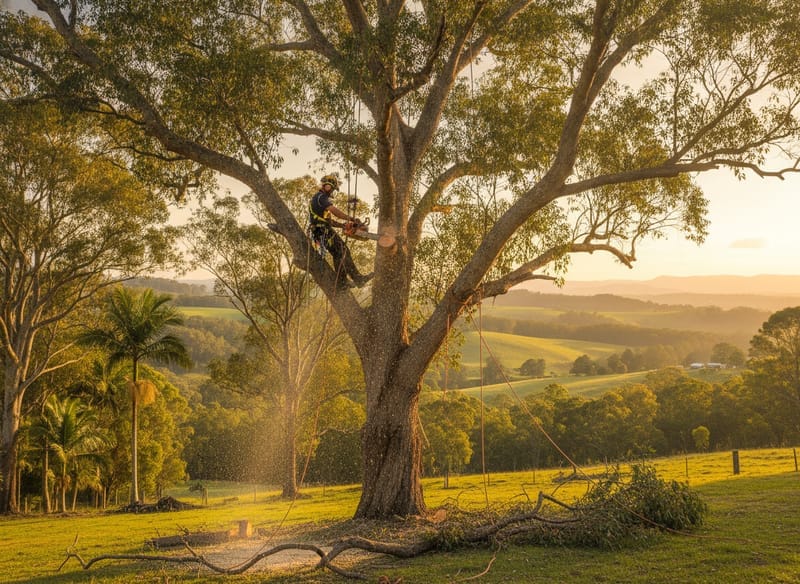
For trees overhanging homes or tight side-gaps in Bundaberg South, we use friction devices, pulleys, and heavy-duty rigging ropes. This allows our climbing arborists to safely lower multi-ton sections of snapped timber directly to the ground without impact.
When a large Hoop Pine or Jacaranda has completely uprooted onto a roof or is too unstable to climb, we utilise loader cranes and mobile cranes. The tree is strapped, cut, and lifted vertically over the house, completely eliminating the risk of secondary property damage.
Fallen trees with exposed root plates are highly unstable. We use mechanical winches or heavy vehicles to secure the root ball before we begin bucking the trunk. This prevents the massive stump from dangerously snapping back into the cavity during cutting.
Once the hazard is on the ground, our ground crews use commercial 12-inch wood chippers and high-powered chainsaws (like the MS500i) to process the canopy. Logs are loaded via skid steers into tipper trucks, leaving your property safe, clear, and ready for repairs.
When you call us for emergency assistance, our process is designed to act quickly while fulfilling all insurance and safety requirements. Step one is the call-out and site triage. We secure the immediate area, identifying live powerlines and unstable structures before our climbers even touch a saw. Step two focuses on documentation and quoting. We understand that storm recovery often involves insurance claims. Before commencing work, we take comprehensive photographic evidence of the fallen or damaged trees in situ. We then provide a detailed, line-itemised quote that breaks down the cost of each specific tree, which you can submit directly to your insurer to streamline your claim. Step three is the make-safe operation. If weather conditions are still poor, we will focus solely on defusing immediate threats—cutting away the limb resting on your roof or winching a leaning trunk away from your boundary line. Step four is the complete removal and processing. Once the immediate danger is neutralised, our team will systematically break down the remaining timber, process the brush through our heavy-duty chippers, and use mini-loaders to remove heavy logs. We leave your Bundaberg South property neat, safe, and fully accessible.
Our operations are anchored in strict adherence to Australian Standards, primarily AS4373 (Pruning of Amenity Trees). Even during emergency cleanups, we ensure that any retained but damaged trees are pruned cleanly to the branch collar, giving them the best chance to heal without inviting fungal decay.
Every member of our climbing crew holds AQF Level 3 in Arboriculture and the necessary high-risk work tickets, including Elevating Work Platform (EWP) and Working at Heights. We are fully public liability insured and carry comprehensive WorkCover for our staff. We also operate in accordance with AS4970 guidelines for tree protection, ensuring heavy machinery used during our storm cleanup doesn't compact the structural root zones of the healthy trees you are trying to save.
Tree removal in our region is typically governed by the Bundaberg Regional Council Planning Scheme 2015, particularly the Biodiversity areas overlay and the Heritage and neighbourhood character overlay which covers parts of Bundaberg South.
However, following severe weather events, disaster exemptions are often activated. Following the devastating Burnett River floods of March 2026, a state disaster clearing exemption is in place until 9 March 2027. This allows property owners to clear vegetation where it is strictly necessary to prevent property damage or remove fallen woody debris, without needing a formal council approval.
Even with this exemption, it is critical to photograph the hazard beforehand and maintain written justification. Please note that Council street trees fall strictly under Local Law 1 (Administration). If a street tree has fallen onto your boundary, you must report it to Council; our teams can only work on private trees or where explicitly authorised.
Once the fallen timber is cleared, the remaining trees on your property require close monitoring. The extreme winds of a Bundaberg summer storm can cause micro-fractures in branches that may not fail until weeks later.
Watch for sudden dieback, weeping sap, or fungal conks appearing on the trunks of your retained Mangos or Jacarandas. Also, monitor the soil around the base of large trees; if you notice ground heave or cracking on one side, the root plate has been compromised. If you spot any of these warning signs, or if a tree begins producing dense, weak epicormic growth, call us back to arrange an AQF Level 5 arborist assessment before the next wet season arrives.
Storm damage tree removal pricing in Bundaberg South is based on the scale of tree failure and the total volume of debris.
We supply transparent, comprehensive quotes covering all cutting, chipping, and waste disposal.
We provide comprehensive storm damage tree cleanup throughout Bundaberg South and neighbouring areas.
Contact our Bundaberg South crew for professional storm cleanup and insurance-ready work.
Request Storm Cleanup Quote