Smooth Council Approvals
Avoid costly DA planning delays by submitting compliant, professional tree impact assessments.
Authoritative AQF Level 5 consulting arborist reports for development applications, tree health assessments, and risk audits in Bundaberg East.
Providing consulting services across Bundaberg East and the greater Bundaberg region
When submitting a Development Application (DA), addressing overlay mapping, or resolving a structural tree dispute, an official arborist report in Bundaberg East is essential. Our AQF Level 5 consulting arborists evaluate health, structural integrity, and retention value to produce comprehensive legal and planning documents.
Developments in Bundaberg East often encounter sensitive riparian buffers, character streetscapes, or mapped biodiversity overlays that mandate formal AQF 5 sign-off before ground disturbance.
Avoid costly DA planning delays by submitting compliant, professional tree impact assessments.
Understand the true health and remaining safe life expectancy of significant trees on your land.
Secure defensible documentation for insurance, liability management, and body corporate compliance.
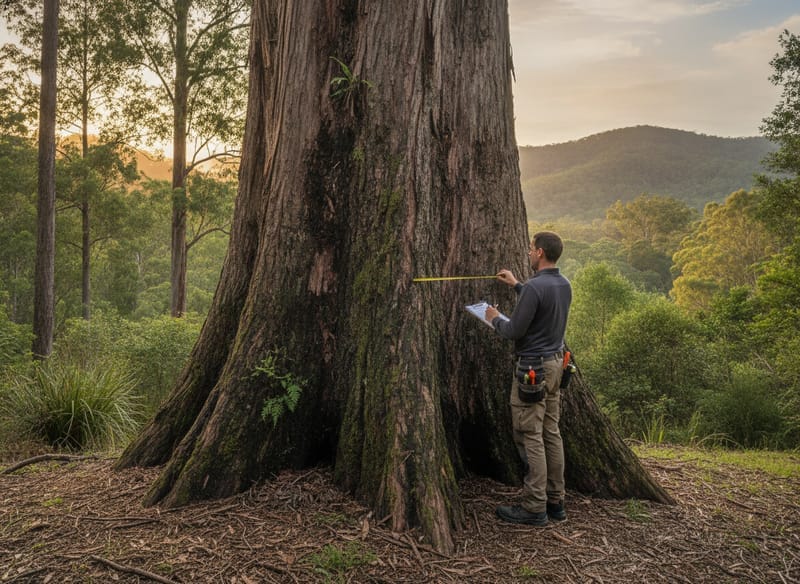
Our AQF Level 5 arborist inspects the tree, measuring DBH, canopy spread, defect symptoms, and root zone vitality.
We overlay proposed site plans against Tree Protection Zones to assess building impacts.
We draft a comprehensive report complete with photos, CAD mapping, health matrices, and formal recommendations.
You receive a finished PDF report ready for direct submission to Bundaberg Regional Council or your certifier.
If you are planning a development, resolving a neighbour dispute, or managing large heritage trees in our subtropical climate, a formal Arborist Report Bundaberg East is the crucial first step. We provide comprehensive, AQF Level 5 consulting arborist reports for homeowners, acreage owners, builders, and property managers across Bundaberg East and the surrounding suburbs.
Whether you need to clear a block on the Burnett flood plain, manage vegetation in newer estates like Ashfield, or assess a storm-damaged Moreton Bay Fig leaning over your roof, our team delivers accurate, legally recognised documentation. We understand the specific demands of the local council and the urgency that comes with managing canopy assets through our volatile wet summers.
An accurate report does more than just tick a regulatory box for developers. It provides a clear, scientific assessment of tree health, structural integrity, and risk. By engaging our expert team, you ensure you have the right evidence to protect your property, safeguard your family, and keep your construction project moving without expensive regulatory delays.
One of the most common delays in local property development or hazard management is submitting a tree assessment completed by an under-qualified operator. Local authorities simply will not accept a few brief notes scribbled by a general tree lopper. If your documentation lacks a genuine AQF Level 5 arborist sign-off, the council will reject your application, stalling your build and costing you thousands in holding delays and redesign fees.
DIY assessments or relying on uncertified advice also exposes property owners to massive liability. If a structurally compromised Hoop Pine or an aging backyard Mango tree fails during our intense summer storms, having no formal documentation means you have no proof of your duty of care. This can lead to denied insurance claims and severe legal headaches, especially in neighbour dispute scenarios where overhanging branches are causing property damage.
Worse, clearing trees within mapped council overlays without an approved justification report can lead to severe financial penalties.
We solve this by providing authoritative, compliant reports. Our consulting arborists undertake rigorous Visual Tree Assessments (VTA) and calculate precise Tree Protection Zones (TPZ). We give you the definitive, legally sound paperwork required to satisfy council planners, insurance companies, and provide absolute peace of mind.
Our consulting team delivers detailed, compliance-driven documentation tailored to your specific project needs. Whether you are subdividing a block, fighting an insurance claim, or protecting heritage canopy during a major renovation, we utilise advanced arboricultural methods to provide definitive answers.
Required for construction near protected vegetation. We document tree species, Diameter at Breast Height (DBH), Safe Useful Life Expectancy (SULE), and provide clear retention or removal recommendations for council planners.
We calculate Structural Root Zones (SRZ) and Tree Protection Zones (TPZ) for construction sites. Includes specifications for temporary fencing, root mapping, and supervised work zones to ensure heavy machinery does not compact vital root systems.
Using Visual Tree Assessment (VTA) methodologies, we map structural defects, target zones, and failure likelihood. This is essential for pre-purchase inspections, duty-of-care logs, and assessing large suburban trees near homes.
Detailed condition reporting to justify the removal of dead, dying, or dangerous trees located within local overlays. We provide the scientific evidence needed for approval, complete with replanting schedules.
Delivering a comprehensive and compliant tree assessment starts with a detailed on-site consultation. When you book us for a project, our consulting arborist arrives to thoroughly inspect the specific trees and the broader site context. We carefully note site access, flat but sometimes waterlogged terrain, overhead powerlines, and proximity to critical infrastructure. Next, we conduct meticulous field data collection. We measure the Diameter at Breast Height (DBH), assess canopy health, and identify the exact species—whether it is a coastal Casuarina out near Bargara or an inland Forest Red Gum. We evaluate structural defects, disease presence, and pest infestations using industry-standard Visual Tree Assessment (VTA) methods. During this phase, we also cross-reference your site against the current Bundaberg Regional Council planning scheme to identify any active overlays. Once the field data is secured, we return to the office to draft the formal documentation. We calculate all necessary protection zones and compile high-resolution site photography, CAD-ready site plans, and actionable, scientifically backed recommendations. Finally, we deliver a finalised, signed PDF report. You receive a legally sound document ready for immediate submission to the council, your architect, or your insurance provider. We also provide a seamless transition to our AQF Level 3 climbing crew, offering a clear quote for any required physical pruning or removal work outlined in the report.
Every report we produce is authored by an AQF Level 5 Diploma-qualified consulting arborist, which is the mandatory standard for Bundaberg Regional Council submissions. We are fully public liability insured and carry appropriate WorkCover for all site visits and field data collection.
Our assessments rigidly adhere to AS4970 Protection of Trees on Development Sites and AS4373 Pruning of Amenity Trees. Whether we are mapping an Asset Protection Zone for the Bushfire hazard overlay or calculating root zones for a new driveway in Bundaberg East, our documentation guarantees full regulatory compliance.
Writing an Arborist Report Bundaberg East requires deep knowledge of the local environment. Our subtropical climate and history of severe weather—most notably the devastating March 2026 Burnett River flood—mean tree risk profiles change rapidly here. The ground gets incredibly soft precisely when the high winds hit, driving whole-tree failures on the river flats. While a current state disaster exemption allows for the clearing of immediate storm and flood hazards until March 2027, all other works require careful navigation of local planning laws. Many older properties fall under the Heritage and neighbourhood character overlay, and properties near waterways often trigger the Biodiversity areas overlay code. This means seemingly routine removals of large mature trees require formal approval. Our team understands exactly how to structure your assessment to address these specific overlays, ensuring your DA or hazard removal application has the best chance of swift approval.
Once your report is delivered, the next step is decisive implementation. If your report is for a property development, you will need to submit the PDF directly to the council alongside your DA and ensure the specified AS4970 tree protection fencing is installed before breaking ground.
If the report recommends remedial pruning, crown reduction, or hazard removal, our AQF Level 3 climbing arborists can step in to execute the physical work to exact AS4373 standards. We recommend scheduling a follow-up visual inspection every 12 to 18 months for retained mature trees, ensuring their canopy health and structural stability continue to thrive in our local climate.
Consulting arborist report fees depend on the number of trees surveyed, project complexity, and the report type required.
We supply fixed-fee written proposals for consulting reports with clear turnaround schedules.
Our consulting arborists service Bundaberg East and all surrounding urban and coastal sectors.
Contact our consulting arborists for expert development assessments and council-ready reports.
Request a Report Quote